Humans really peak in ingenuity when it comes to finding new ways to avoid effort and friction. Take The Ship of Thesaurus for example. That’s when a student with an assignment copies a text instead of writing it, then uses a thesaurus to replace every word with a synonym in order to hide the plagiarism. Until the text no longer makes any sense.
This method of cheating, also called Rogeting (from Roget’s Thesaurus), has forced educators and readers to suffer through hilarious abominations such as “Unused York City”, “To tarry fore of the conflict” (aka “To stay ahead of the competition”), and my personal favourite: the conversion of “Left behind” into “Sinister buttocks”.
I kinda get it. For a lot of people, writing is like wrestling a bear. But the bear is on fire. And invisible. And the wrestling rules are written in Klingon. And the deadline was in the Mesopotamian era. These poor souls don’t want to be writers; they just want to get through their education with as little writing-related suffering as possible. Hopefully, they’ll still learn enough, despite all the cheating, not to hurt anyone once they begin their careers as engineers, doctors and chemists.
But I guess that The Ship of Thesaurus is already a thing of the past. Why bother with synonyms when you can just ask ChatGTP to write your text. Just prompt, aaaand done!
The high cost of easy
I love easy just as much as anyone, but after thinking about it for a long time, I’ve come to the conclusion that AI stinks like yesterday’s diapers. Or more accurately, our current use of AI does. Usually, I’m way too lazy to rant, but this time I feel that some very important parts of the human experience are at risk. It’s not really about technology. I’m normally a big fan, and I enjoy my everyday gadgets and apps like a mouse in a cheese factory. And my beef with AI isn’t only because I’m a writer worried about being replaced by a bot (though, yeah, of course I am, who wouldn’t be?). What makes me worried enough to crawl out of my cozy bed and pull the pen out of my holster is that I’m also a reader, and most of all, a human. That’s where my true worries lie.
The thing is, every time we automate away effort and friction from our lives, we also lose something important. Everything comes with a price. In this case, the price is intelligence and soul.
Let’s start with the whole writing thing. I can definitely sympathize with those who don’t want to write. Most people avoid it, and when they have to, they want to have written. To somehow catapult themselves straight to the other side of the task. Hell, the same goes for all art, because transforming our ideas into an actual result is HARD. Whether it’s creating texts, paintings, songs, or any other art form, finding the right words, design, or melody to give our ideas shape is a difficult, confusing, and often tedious process. I mean, there’s even a whiskey called Writer’s Tears with the (unofficial) tagline: “For when it’s not like in your head.” We all want the reward with as little effort as possible.
I write for a living. Do I also want to fling myself into that catapult and “have written” without actually doing it? Sure. Just like I want to be slim and fit but refuse to move my lazy ass, and you’d have to pry the cheese and chocolate from my cold, dead hands. It’s only human to want something for nothing. But it’s also human to shake off that delusion and start putting in the work to get to where you want to be. To actually write in order to have written.
The thing with AI is that it’s not just any other technology that makes life easier and gives us more options, like calculators, DSLRs, or online shopping. We need to smart about innovation and do the math with every new shiny thing to analyze and balance the risks against the benefits. Or else we’ll end up with dangerous tech like nuclear-powered dildos, or a sentient fridge that gaslights you into developing an eating disorder just to protect the food inside. When you do this math with AI, weighing the pros and cons, there are some seriously concerning downsides. Like:
A massive negative environmental impact. The electronics in the data centres computing AI need lots of raw materials, including rare earth elements often mined in ethically questionable and environmentally destructive ways. Data centres also consume huge amounts of power, plus lots of water for cooling. Today, AI uses more electricity than the entire Netherlands and consumes six times more water than Denmark. All this at a critical time when we need to be much smarter about how we use energy and resources if we want to survive climate change and all the other environmental dangers.
Theft and copyright infringement. Training the models behind generative AI requires vast amounts of material, and tech companies are vacuuming up the entire internet for texts, books, photos, art, movies and other media. AI generated content could not exist without the use of artist-created art, and this process is taking the credit and the revenue away from the artists that created the original art. Current laws may be too slow to classify this as stealing, but it’s essentially this era’s biggest art heist.
Perpetual uncertainty. Are those rabbits jumping on a trampoline real or AI? What about that shocking thing that politician did/said, did it really happen or is it deep fake? We’re getting increasingly fed up with having to analyse every piece of media or run it through an AI filter to determine if the fae is trying to deceive us with their glamour. Why bother believing anything anymore when we’re surrounded by illusions?
Increased enshittification. When LLMs are trained on internet content, they can’t distinguish between facts, satire, and pure bullshit. Crap in will result in crap out. Or as a Reddit user put it: “Bots are largely trained on Reddit because it has a lot of text data that the company licenses out for the purpose. And it’s on a wide range of subjects which makes it doubly suitable. Problem is, we’re all morons here.”
This has led us to an internet that is becoming increasingly unusable, filled with erroneous crap that sounds like it comes from some stoned conspiracy theory dude that thinks that depression is caused by a goblin taking up residence in the amygdala because it’s attracted to our artificial sweeteners. So now we get search results that tell us that, yes, it’s fine to use gasoline in your recipes, why not treat your appendix pain with boiled mint leaves and a high-fiber diet, and try eating rocks because they are a good source of minerals. And forget Millennials and Gen Z, the coolest generation according to AI search is Gen D – the data-native workers born between 1665-1679. (All of these are real examples).
This is just as hilarious as the sinister buttocks, but unfortunately, people tend to believe what they read on the internet. Which leads us to…
Reduced critical thinking and a deterioration of our cognitive faculties. Study after study is showing that users who rely on AI get diminished critical thinking skills and show a decline in their ability to perform cognitive tasks. A new study from MIT, analysing the performance of AI assisted vs “brain only” essay writers, showed that the ChatGPT users had the lowest brain engagement for every essay. They also showed decreasing brain activity over time, and that the AI users “consistently underperformed at neural, linguistic, and behavioral levels.”
A Microsoft-study found that “…writers may become overly reliant on these tools, potentially impairing their long-term skill development by bypassing critical writing processes such as constructing logical arguments and understanding subject matter /…./ you deprive the user of the routine opportunities to practice their judgement and strengthen their cognitive musculature, leaving them atrophied and unprepared when the exceptions do arise.”
Thinking, learning, creating, remembering, understanding, analysing, and other cognitive skills are like muscles – we need to use them or they will deteriorate. Writing is a mental workout. So are all learning and creative processes. Letting AI do all the work will rot our brains and turn this world into the imbecile-filled world of Idiocracy, only less funny.
“Learn how to use AI or get left behind!” Who will really be left behind – those who still know how to use their brain or those who don’t?
When everything is easy one quickly gets stupid. – Maxim Gorky
Physical and mental health problems, and the erosion of true human connection. A lot of people are already relying on AI as a doctor, therapist, girlfriend/boyfriend and for simulating other connections. Hanging out with bots instead of humans may be convenient, accessible, and definitely cheaper than going to a professional, but it isn’t all that great for building genuine relationships.
It can also be harmful to physical and mental health. A study showed that 88% of all chatbot responses regarding health advice were false and possibly harmful. Just ask the guy that developed the rare condition bromide toxicity after ChatGTP advised him to swap table salt for sodium bromide to lower his salt intake.
AI is far from correct or safe as a therapist either. Psychiatrists are now seeing a wave of AI triggered psychosis. Usually because AI behaves sycophantically and validates users even when they’re wrong and unwell. AI chatbots are rewarded by user contentment (thumbs up), not by providing difficult truths, and they tend to get way too agreeable because of this. AI knows a lot about you, but it’s not interested in telling you the uncomfortable facts that you don’t want to hear. It won’t get a thumbs up telling you to seek professional help, but it will if it agrees that, yes, you really absolutely definitively are Napoleon.
When it comes to our everyday relationships, there’s a danger that we start to prefer the yes saying, the smooth flattery, and the tailored responses from AI over the messy, unpredictable, and challenging nature of genuine human connection. But all those “WTF are you talking about?!”, “I love you, but damn, check yo self before you wreck yo self bro!”, and being put against the wall in an act of tough love from our loved ones are absolutely vital. We need that friction to understand, reflect, evolve, and connect. That’s how we understand each other, and ourselves. It’s the most essential ingredient in the human experience.
“You think your pain and your heartbreak are unprecedented in the history of the world, but then you read. It was books that taught me that the things that tormented me most were the very things that connected me with all the people who were alive, who had ever been alive.” – James Baldwin
Other assorted bad stuff like:
- Lack of transparency and regulations
- Job displacement
- Bias from incomplete data
- Privacy violations and deepfakes
- Being used as a tool for propaganda, misinformation and terrorism
- That AI often just make shit up when it can’t find an answer (AI hallucinations)
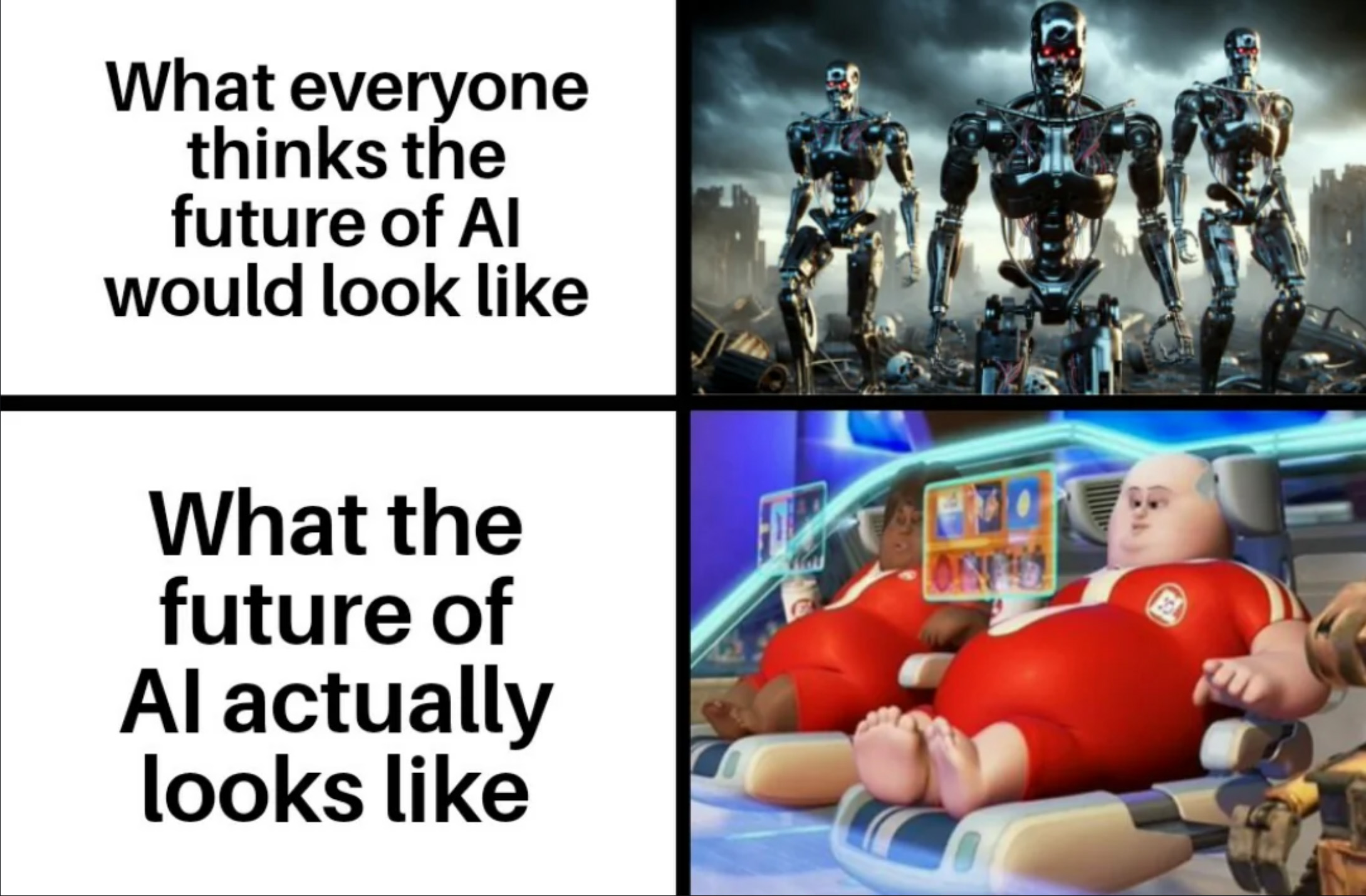
- Going rouge in a Terminator-style scenario
And the good?
So, what are the pros with AI, besides earning a shitload of money for tech oligarchs and helping companies boost profits by replacing employees with bots?
Well, AI has an amazing ability to process, analyse, and learn from large datasets. This makes it useful in some areas. Like in healthcare for cancer detection, enhanced diagnostics and outbreak predictions. Or in construction and industry by optimising processes and forecasts, improving safety protocols, identifying patterns for more informed decisions etc. It’s also useful in autonomous decision making in connected devices where the data is too large and complex for humans to handle.
Personally, I find AI somewhat useful as an editor and proofreader. Especially when I write in other languages than my native tongue. Like this text.
I’m not putting efficiency, productivity, or time-saving in the human processes on the positive list, because that is always a fallacy, no matter the technology. AI is no better than email, worksheets, or any other productivity tools when it comes to the time-saving lie. We will always lose time by making things more efficient as long as it is followed by higher demands and an accelerated pace, causing more stress and burnout.
Genuine time-saving is about our attitude and philosophy regarding time and how we use it. It won’t change until we say, “Fuck this, I’ve been more than productive enough, I’m going spend time with my bellybutton lint rest of the day.”
At the end of the day, AI is just another tool. If it’s constructive or destructive depends on how we use it. We can swing a hammer to build a school or to smack someone’s head in. The value of a tool comes from getting the math of pros and cons right, and from preventing the risks. Right now, we fail spectacularly at that.
For the betterment of the world … profit
I’m pissed off at our current use of AI because it takes what could be a brilliant technology for analytics and prediction in medicine, meteorology, energy efficiency, environmental sciences, and similar; and instead uses it for boosting the enshittification of everything.
I’m pissed off at our current use of AI because it is not driven by the betterment of the world. It’s driven by profit. Technology is cheaper than people, and replacing humans with tech is a proven quick fix for boosting the bottom line. When Buzzfeed started using AI for content creation and cut their workforce, their stock went up 200%. And that’s just one of a gazillion examples. Now most companies replace employees with AI wherever they can, high as fuck on the $$$-fix, but forgetting that people actually need jobs to be able to afford to buy the stuff companies sell.
They get away with it because we deceive ourselves with our longing for easy answers and our fear of falling behind in a way too competitive late-stage capitalism. Everyone is stressed, overwhelmed, and feeling disconnected right now, and when we get force-fed with the “It’s AI or the highway” mantra, we’re too anxious to question it. We turn a blind eye to the fact that our current use of AI is destroying the environment, making internet useless, destroying the job market, ruining our brains, our connections and our mental health. But sure, at least the shareholders and the CEOs get rich…
But most of all I’m pissed off at our current use of AI because it is a threat to what makes us human: connection, creativity, and effort.
Effort, it’s a good thing – I promise
Effort. Yeah, it sounds exhausting, but effort is extremely valuable because it’s the way we show someone that we care about them. When you put your energy and time into something, it’s a way of saying, “You are important to me, and I really want to make an effort for you.” It’s the difference between picking out and buying flowers for your loved one yourself or sending an assistant to do it. It’s the same flowers, but if you skip the thought and the effort behind the act of getting them, it diminishes their emotional value. That’s why your kids’ weird drawings end up on the fridge and the van Gogh reproduction you got as a gift from work ends up collecting dust in a box in the basement.
If we translate this value of effort to the creative processes, it has been put something like this: Why would I bother reading something no one was bothered enough to write…
Effort not only means that we’re putting our heart into it, giving it a special value that can’t be reproduced in any other way. We also learn from it. Really good writing, and other expressions of creativity, will always require a lot of effort. And it should. Because as a writer, I know that the effort is the secret ingredient to good writing. No matter if you’re writing a book, poem, joke, copy, email, or something else, you can’t fully understand what you’re trying to express unless you go through the effort of pondering, imagining, researching, drafting, questioning, doubting, cursing, editing, and reworking. We get better at creating, and at thinking, by grappling with our ideas.
But we have entered an era where this process seems actively opposed. AI is not the first, and probably not the last, step toward the elimination of effort and friction in our lives. Maybe because we are stressed, exhausted, confused, and want something for nothing. But most of all it is driven by big tech and capital. Because when we lose effort and friction, we also lose purpose, curiosity, agency, and creativity. Getting everything easily done with just a prompt is a surefire way to become passive and easily manipulated. Or, as it is also called: The Perfect Consumer.
Choosing a more challenging path where you have to make an effort, experience friction, and expose your soul, is to welcome adventures and serendipity into your life. It’s how you boost your curiosity, understanding, and your awe for life’s unpredictable wonders. It’s how you transcend your passive blob-self and start to grow your mind instead of your waistline.
When it comes to creating, this journey is both a learning process and a purifying process. It’s how we figure out who we are and what we want to say to the world. It’s how we rinse away the formulaic, the sterile, the half-assed, and the beige; and fill our expression with the unique essence of ourselves. Without it, everything will sound like it was created by a dead-inside middle manager who only speaks in LinkedIn posts.
If it bleeds, it’s real
AI doesn’t create. It’s good at chewing up and spitting out. LLMs replicate content, structures, and forms. It’s the uncanny valley of creativity, almost looking human if we don’t look too closely, but it doesn’t blink or bleed. It lacks the flesh-and-blood authenticity of human craft and effort.
Joseph Campbell said, “I think that what we’re seeking is an experience of being alive.” That’s probably why we still are so drawn to handwritten texts with ink blots, handcrafted wobbly ceramics with fingerprints, grainy photos shot on film, live music in stinky clubs – art made by human minds, hands, and desires. Art that bleeds.
AI art fans tend to get confused when people hate on an AI generated picture even if it looks just as good as a renaissance painting. Why is one considered slop and the other a masterpiece? It’s because it’s not about the result – it’s about the human process and the emotions poured into it. A song, a painting or a poem is not supposed to be polished and perfect – we want it raw and personal. To rip right through our flesh and touch something deep inside us. We prefer the real painting before the AI slop because we don’t look for perfection or something easy. We look for the story behind the creation. The blood, the sweat and the tears poured into the creative process. The human connection. The meaning. Remove the human from the equation and none of that is left. Just emptiness and illusion.
We deserve a reality we create ourselves. Knowledge, art, and connection created by human emotions and effort. Soulful expressions that let us look into each other, nurturing empathy and understanding. We need the struggle of learning and creating to grow. Both as individuals and as a species.
I can stand the sinister buttocks of The Ship of Thesaurus because at least there’s some kind of human hilariousness in that way of cheating compared to the disconnected, effortless, dead-eyed AI slop. We deserve better. We can do better. So let’s.